Before the Four-Lane Roads: James Thomas “Tom” Seely Remembers Growing Up in Justin
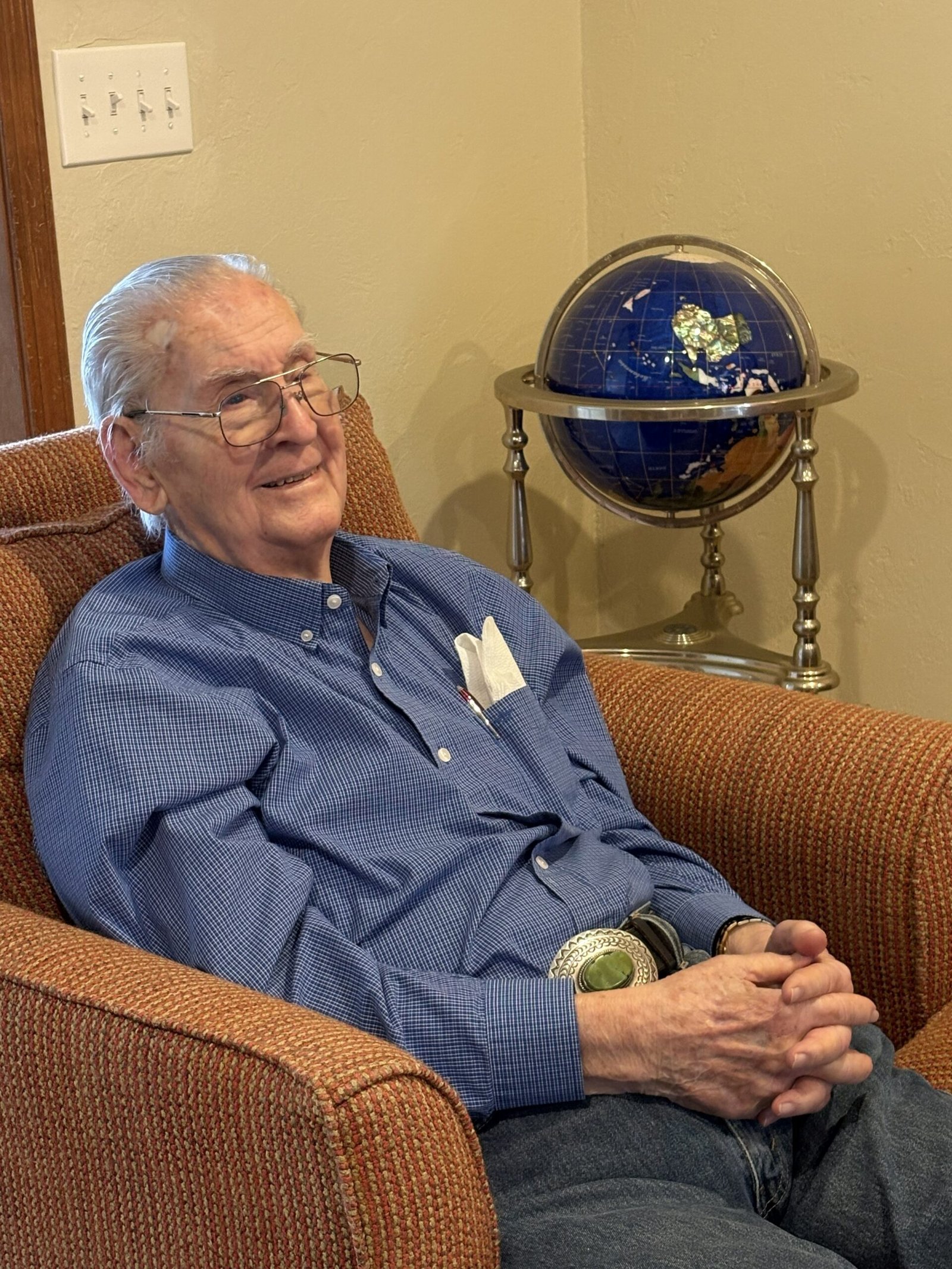
If you ask Tom Seely about his earliest memories of Justin, he doesn’t start with a date or a particular building. He starts with mule-drawn wagons.
“I used to watch mule pull wagons down the street,” Seely recalled. “And just watch them and think, man, it’d be fun riding that wagon.”
That was Justin when Seely was growing up. It was a small farming community where people knew one another, children walked to school, and much of everyday life revolved around farms, local businesses and the people who ran them.
Seely attended school in the Justin Independent School District and graduated in 1946. There were only 13 students in his graduating class.
School was different then, too. Recess meant everyone went outside to “work a few wiggles out,” as Seely put it, and teachers were often people students knew from around town. Many of them lived in the community, so the relationship between school and town felt much closer than it does today.
There weren’t many male teachers. Seely remembers the superintendent, his assistant and a coach, but most of his early teachers were women who lived and worked in the area.
And if a student got out of line, there were consequences.
Seely still remembers one particular paddle belonging to Mr. Cox. He described it as being about three-quarters of an inch thick with holes drilled through it. When asked whether it hurt, he didn’t hesitate.
“Yeah,” he said, laughing.
Justin During the War
By the time Seely was a teenager, World War II had changed life in Justin and across the country. Some local residents were finding work in Fort Worth, including jobs connected to wartime manufacturing, and there was a little more money moving through the community.
But there wasn’t much room for waste.
Gasoline, tires, shoes and other goods were rationed. Families needed stamps to purchase certain items, and even something as ordinary as a pair of shoes required planning.
“You didn’t waste anything,” Seely said.
Justin was still primarily a farming community, and families depended heavily on what they could grow, raise or buy locally. There were several grocery stores in town, and Seely remembers a time when residents didn’t have to make a trip to Denton just to buy groceries.
He remembers Adams Grocery on Fourth Street, where people could buy groceries and dry goods. Customers received tickets with their purchases, and nearly every Saturday the store held a drawing for baskets of groceries. The grand prize could be worth several dollars and included a large basket filled with canned goods and other food.
For a family living on a modest income, a basket of groceries was worth winning.
His First Job Was Pouring a Floor
Seely’s first job came when he was only 13 or 14 years old. He helped rebuild a local building where the wooden floor had deteriorated and needed to be replaced with concrete.
There wasn’t a concrete truck showing up to do the work.
They used an old portable cement mixer, measuring out gravel, sand and cement before mixing it and hauling the concrete by wheelbarrow. Seely remembers working alongside Jay Hilton, and he still remembers the work because, as far as he knows, that concrete floor is still there.
It is one of those details that makes his memories of Justin feel surprisingly close. A teenager helping pour a floor more than 80 years ago may still be walking past the same concrete today.
Baseball, Football and Cold Cokes
Free time in Justin often meant sports.
Seely remembers baseball and softball being played across from the school, on what had also been used as a football field. There were bleachers and lights for nighttime games, and people would come straight from working on their farms to play or watch.
A small concession stand added to the experience. The person running it would start icing down the Cokes around noon so they would be cold by the time the ballgame started.
Justin’s football program was much smaller than anything today’s residents would recognize. The school had played six-man football, but there were periods when there simply weren’t enough boys to keep the program going. During the war years, there were also problems getting uniforms and gasoline for travel.
The community still found ways to gather, though. A ballgame was an event, and people showed up.
When Cotton Came Through Town
Cotton was another major part of life in Justin. Seely remembers when the town had three cotton gins, including one east of the railroad depot and others farther out toward County Line Road.
Today, it’s difficult to picture wagonloads of cotton coming through Justin, but Seely remembers exactly that.
“You’d see wagon loads of cotton coming down behind a couple mules,” he said.
He also remembers one frightening accident involving his brother, who worked at one of the gins. His brother reached into the machinery to retrieve something and was pulled into it. Seely happened to be nearby with a bale of cotton on a trailer behind his pickup.
His brother came running down the stairs, and Seely quickly unhooked the trailer, lowered the tailgate and helped him into the back of the pickup. They headed toward the doctor’s office, where Seely helped get his brother inside.
Then Seely went into the nearby restaurant for a glass of water. He passed out. “When I woke up, Tootsie was washing my face,” he remembered. He was about 18 at the time.
The Service Station Was a Gathering Place
Seely also remembers working at a local service station, where the job involved much more than pumping gas.
There was a wash rack and a grease rack in the back, and rainy days were especially busy. When farmers couldn’t get into the fields, they’d bring their vehicles in to be washed, serviced and greased.
While the work was being done, people sat around and visited. They drank Cokes and ate peanuts. They talked about whatever was going on around town.
“It was like everybody visited one thing or another,” Seely said.
A Coke cost a nickel. The bottles were kept in old drink boxes, and customers opened them with a church key. Seely even remembers an old trick involving the vacuum hose on Chevrolet pickups that could be used to reach into the drink box.
He laughed while explaining it.
The service station wasn’t just a place to get a vehicle serviced. It was one of the places where people naturally gathered.
Life at the House on First Street
Some of Seely’s most detailed memories involve his grandparents’ home on First Street.
His grandparents built the large house and moved into it in 1913. They had 11 children, and moving into town gave the children better access to school. Behind the house were several acres, a barn with four stalls and a hayloft, and land that connected to a larger farming area.
The family kept cows, hogs and chickens. They had a garden and grew much of the food they ate.
During the winter, they might butcher five or six hogs in a day. Corn and other vegetables from the farm were brought into town, prepared and canned. A cellar behind the house provided a place to store the food.
Seely remembers the old washing machine, too. It had a small motor attached to it, and Monday mornings meant firing it up while the children carried water and helped with the laundry. Sheets were hung on the clothesline to dry.
His mother used to say they were poor, but she also pointed out that they never went hungry.
They had a farm. They had animals. They grew food.
That didn’t mean life was easy. It meant the family had ways to take care of itself.
Neighbors Took Care of Neighbors
That same idea extended beyond the family.
Seely remembers a time when people in Justin took care of one another in ways that weren’t formal or organized. If someone died, neighbors helped with the funeral and even dug the grave. If a family was having financial trouble, people would take up a collection.
Nobody had much to spare. But several people giving a little could make a difference.
Seely remembers people working for only a few dollars a day, so even a five-dollar bill was meaningful.
It was simply how things worked.
Watching Justin Change
Seely has watched Justin change in ways that would have been difficult to imagine when he was a child.
The streets he remembers as gravel are now busy roads. FM 156, for example, was once a gravel road heading toward the Tarrant County line. He remembers the contrast when the road became paved in Tarrant County, although it wasn’t particularly wide and still had plenty of potholes.
Today, that same corridor carries traffic throughout the day.
Farm equipment changed, too. Seely remembers when machines went from handling two rows to four, and eventually much more. The technology transformed farming, just as better streets, water and sewer systems transformed the town itself.
And then there was television.
When TVs first appeared in Justin, Seely remembers a furniture store putting one in its front window. On weekends, people would gather outside and watch through the glass.
“There’d be half a dozen men or more standing outside that window looking through the glass at the TV watching the football.”
It sounds simple now. At the time, it was something worth stopping for.
What He Hopes Justin Doesn’t Lose
Seely has opinions about Justin’s growth, and he’s not shy about sharing them.
He understands that farmland doesn’t stay farmland forever. Families sell property, developers build on it, and the town expands. But he would still like to see more attention paid to the center of Justin.
He’d like to see the empty spaces downtown put to use and Old Town remain active.
At one point, he even suggested moving City Hall into the center of town.
He remembers buildings that once served completely different purposes and families whose names were familiar to everyone. He mentioned Charlie Sims, Ruth Harris and Newton Knox — people whose names were part of everyday conversation when he was growing up.
For newer residents, those names may mean nothing.
For Seely, they are part of the map of Justin.
He remembers the old Baptist church that once stood where another building is today. He remembers Pennington College and the buildings associated with it. He remembers cotton gins, grocery stores, service stations and farms that have long since disappeared or changed.
And he remembers a town where people didn’t necessarily need an appointment to see one another.
They just showed up.
At the service station. At the ball field. At the grocery store. Around town.
Justin is a very different place now, but when Seely talks about it, the old town is still easy to picture: mule-drawn wagons moving down the street, cotton coming into the gin, kids running outside for recess, a nickel Coke at the service station and 13 students sitting together as a graduating class.